
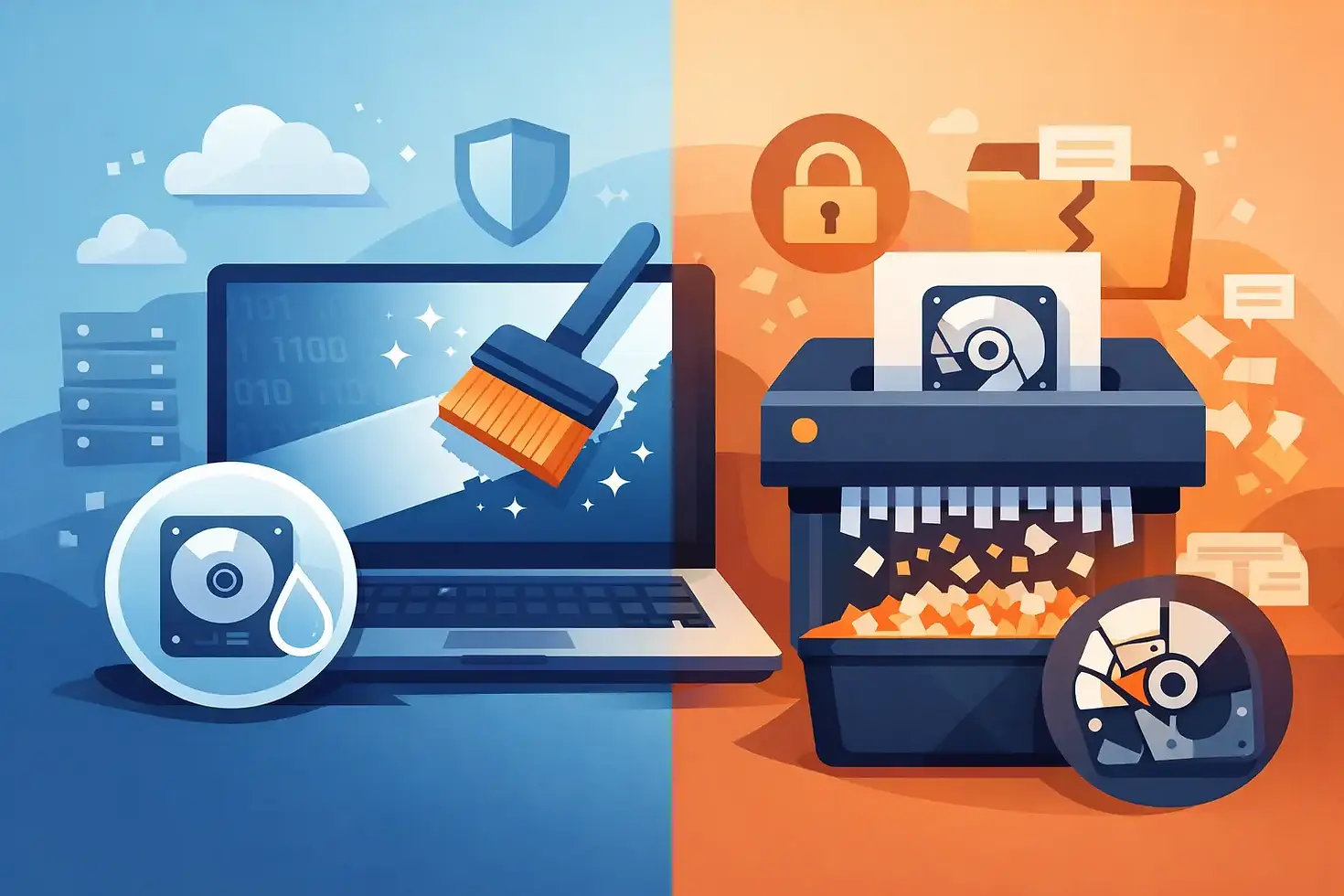
Data Wiping vs Shredding: Which Fits Best?
A retired laptop can still hold customer records, employee data, access credentials, and years of operational history. That is why data wiping vs shredding is not a minor disposal choice. For organizations managing IT refreshes, lease returns, data center decommissions, or surplus equipment, the decision affects security, asset recovery, compliance posture, and sustainability results at the same time.
The right answer is rarely based on one priority alone. If your organization wants to preserve device value and extend asset life, wiping may be the better fit. If the media is damaged, highly sensitive, or cannot be reliably sanitized, shredding may be the only responsible option. The strongest programs do not treat these methods as interchangeable. They apply each one where it creates the most secure and measurable outcome.
What data wiping vs shredding actually means
Data wiping is a software-based sanitization process that overwrites the data on a storage device so the original information cannot be recovered through normal forensic methods when the process is completed to the required standard. It is commonly used on functional hard drives, solid-state drives, laptops, desktops, and servers that may still have reuse or resale potential.
Shredding is physical destruction of the storage media itself. The drive, tape, or other media is broken into pieces so the data cannot be reconstructed in any practical way. This method is often used for failed drives, media with extreme sensitivity, or situations where policy requires physical destruction regardless of condition.
At a surface level, the difference seems simple - sanitize and reuse, or destroy and eliminate. In practice, the decision sits at the intersection of security, logistics, environmental goals, and auditability.
When data wiping is the stronger option
Data wiping is best suited for assets that are still operational and can be processed in a controlled chain of custody. For many enterprises and institutions, that matters because the device itself still has financial and environmental value. A wiped laptop can be redeployed internally, resold, donated, or returned at end of lease with documented sanitization. A wiped server drive may support recovery value from a broader decommissioning project.
This approach aligns well with circular-economy goals because it keeps equipment in productive use longer. Instead of treating every retired asset as waste, wiping supports a managed transition from one lifecycle stage to the next. That creates measurable outcomes in both recovery and landfill diversion.
Wiping also tends to work well when organizations need scalable processing across large volumes of devices. If you are retiring hundreds or thousands of endpoints, a structured sanitization workflow can preserve value without compromising control, assuming the devices are functional and the process is validated.
That said, wiping is only as credible as the process behind it. You need verified software, defined standards, asset tracking, exception handling, and reporting that stands up to internal review and external audits. If a drive fails the wipe process or cannot be accessed, the workflow has to shift immediately to physical destruction. That is where mature IT asset disposition programs separate themselves from basic recycling vendors.
When shredding is the right choice
Shredding is often the right decision when certainty matters more than reuse. If a drive is damaged, encrypted but unreadable, unsupported by sanitization tools, or tied to highly regulated data, physical destruction reduces ambiguity. It removes the question of whether the device could have been fully wiped because the media no longer exists in usable form.
This method is common in environments with strict security protocols, including government, healthcare, finance, defense-related operations, and organizations handling confidential research or legal records. It is also the better option when chain of custody has been disrupted or when storage media has reached a condition where software sanitization cannot be completed and verified.
Shredding can simplify policy enforcement in high-risk environments, but it comes with a trade-off. Once the media is physically destroyed, the asset recovery opportunity is gone. That means lower resale value, fewer reuse pathways, and a more limited contribution to circularity. There is still a responsible environmental path if the shredded material enters a compliant downstream recycling stream, but destruction remains a terminal outcome for the device.
Security is not just about the method
Many organizations frame data wiping vs shredding as a pure security debate, but the real issue is control. A weak wiping process is a problem. A poorly documented shredding process is also a problem. In both cases, gaps in chain of custody, asset reconciliation, exception handling, and documentation create risk.
Security depends on whether each asset is identified, tracked, processed, and matched to a final disposition record. If your team cannot prove what happened to every serialized device, the destruction method alone does not solve the compliance issue. This is especially relevant during office closures, fleet refreshes, mergers, and large decommissioning events where asset volume can quickly outpace internal handling capacity.
Organizations with mature programs usually define decision trees in advance. Functional endpoint devices may go to certified wiping first. Failed drives and unsupported media may go directly to shredding. Exceptions are documented, not improvised. That structure protects data while keeping operations efficient.
Compliance, reporting, and defensibility
If your organization operates under contractual, regulatory, or public accountability requirements, defensibility matters as much as execution. Auditors, procurement teams, legal departments, and sustainability leaders all want different proof points, and your disposition strategy has to satisfy all of them.
For wiping, that typically means device-level records, sanitization logs, software verification, and certificates tied to specific assets. For shredding, it means documented destruction events, chain-of-custody records, and downstream processing transparency. In both cases, broad claims are not enough. Decision-makers need evidence that can be reconciled against inventory and retained for reporting.
This is where an engineered service model becomes essential. A provider should not simply collect retired equipment and return a generic certificate. The process should create visibility from pickup through final disposition, with clear handling standards for different asset classes and media types.
Sustainability changes the equation
The environmental case for wiping is strong because it supports reuse, resale, redeployment, and life extension. Every device that stays in circulation longer reduces pressure on raw material extraction, manufacturing demand, and landfill-bound waste. For organizations with ESG commitments, that is not a side benefit. It is part of responsible asset management.
Shredding still has a role in sustainable operations, but it should be used intentionally. When destruction is necessary, the environmental objective shifts from reuse to material recovery. Metals, components, and commodities should move through responsible recycling channels rather than low-visibility disposal streams.
A practical sustainability strategy does not avoid destruction at all costs. It applies the highest-value outcome that still meets security and compliance requirements. Sometimes that means wiping and remarketing. Sometimes it means shredding and recovering material. The key is making the decision based on measurable outcomes, not habit.
How to choose between data wiping vs shredding
For most organizations, the decision comes down to five variables: media condition, data sensitivity, compliance requirements, reuse potential, and reporting needs. If the drive works, the data can be sanitized to the required standard, and the asset has reuse value, wiping usually delivers the stronger business and environmental result. If the media is compromised, the data risk is elevated, or policy requires total destruction, shredding is the more defensible path.
Many programs benefit from using both methods within the same disposition workflow. Laptops and desktops may be wiped and remarketed. Failed server drives may be shredded. Backup tapes may be destroyed under stricter controls. This mixed model is often the most effective because it matches the method to the risk profile of the asset.
That is also where a consultative partner adds value. The goal is not to force all assets into one channel. It is to build a repeatable framework that protects information, captures remaining value, and supports sustainability reporting without slowing down operations. Blue Revive approaches this as part of a larger lifecycle strategy, where secure handling and measurable environmental outcomes work together rather than competing for priority.
The strongest disposition decisions are rarely the most aggressive or the most conservative. They are the most appropriate. When you align sanitization and destruction methods with asset condition, data risk, and circular-economy goals, end-of-life processing becomes a controlled business function instead of a last-minute compliance exercise.
A better question than whether wiping or shredding is safer is this: what outcome do you need from each asset, and can you prove you achieved it?


Comments